Translate

Sunday, November 8, 2015

Life has been a little crazy!

I haven't forgotten about you! I know it's been a little over a month since I last posted, but I started a new job the week after my last post, so things have been a little hectic. I will return soon though with more family stories and research. (In fact, I've found a couple of yearbooks on Ancestry that pertain to Randolph County and my husband's family.)

In the meantime, I will leave you with this photo of my father-in-law which I found in one of the aforementioned yearbooks.
James Larry Jenkins, 1964
Sources:

  • 1965 Gray's Chapel High School Yearbook (accessed on Ancestry)

Sunday, October 4, 2015

Grady and Winnie L. Wheat

Grady Wheat was born on 6 August 1901 in Tennessee. He was one of at least six children born to Isaac Leroy Wheat and Essie White.

Grady married Winnie Ethel Lineberry in about 1925. She was born 22 February 1904 in Tennessee. She was the seventh of 11 children born to Henry Allen Lineberry and Florence Levona Evans. Together, they had at least the following children:
  • Wilma R. Wheat
  • Reba/Nina L. Wheat
  • Roberta Wheat
  • Douglas E. Wheat
  • Vera D. Wheat
  • Johnny Wheat
They seemed to live in Perry County, Tennessee for their entire lives. They often showed up a few houses down from siblings and cousins.
Clipping from the 1930 Perry County, TN Census
Clipping from the 1940 Perry County, TN Census
Grady died 11 March 1978. Winnie died about a year later in July 1979. They are both buried in Howell Cemetery in Perry County, Tennessee. The following obituary was found on Find-A-Grave for Grady.
Grady's Obituary
So far, I don't have any children for any of his children, so I don't know the names of the 12 grandchildren and eight great-grandchildren he had at the time of his death. If you descend from this family or know the names of any of his grandchildren, send me a message, and I'd love to add them to the family tree.

Sources:
  • Obituary placed in Buffalo River Review on 16 March 1978, Grady Wheat (as posted by Janice Duncan on Find-A-Grave)
  • 1910 Perry County, Tennessee U.S. Federal Census (accessed on Ancestry)
  • 1920 Perry County, Tennessee U.S. Federal Census (accessed on Ancestry)
  • 1930 Perry County, Tennessee U.S. Federal Census (accessed on Ancestry)
  • 1940 Perry County, Tennessee U.S. Federal Census (accessed on Ancestry)

Saturday, September 26, 2015

Peter King

Today's family will feature one of my pseudo-roadblocks in my husband's family. I think I know each spouse and their parents' names, but I have no proof of them. To help sort this family out a little bit, I will try to only focus on the information I can back up with sources. Peter King was born about 1808 in North Carolina.

The 1840 census shows Peter living in West Pee Dee River, Montgomery County, North Carolina.
Clipping from 1840 census
In the household are:
  • Male, under age 5
  • Female, under age 5
  • Female, age 5-10
  • Male, age 20-30 (assume this to be Peter)
  • Female, 20-30 (assume this to be Peter's wife)
The 1850 census shows Peter living in Montgomery County, North Carolina. A wife is not present in the household, but the following children are:
  • Ann E. King, born about 1834 (assume this to be the female 5-10 in the 1840 census)
  • Allen King, born about 1837 (assume this to be the male under 5 in the 1840 census)
  • Dany King, born about 1840 (assume this to be the female under 5 in the 1840 census)
  • Emely King, born about 1845
  • Cummings King, born about 1847
  • Peter King, born about 1849
  • William King, born about 1849
I do not know if all of the children listed in this household are the natural children of Peter, but I assume they are. Some researchers suggest multiple spouses for Peter. I can only prove what I find in records, but more on that in a bit.

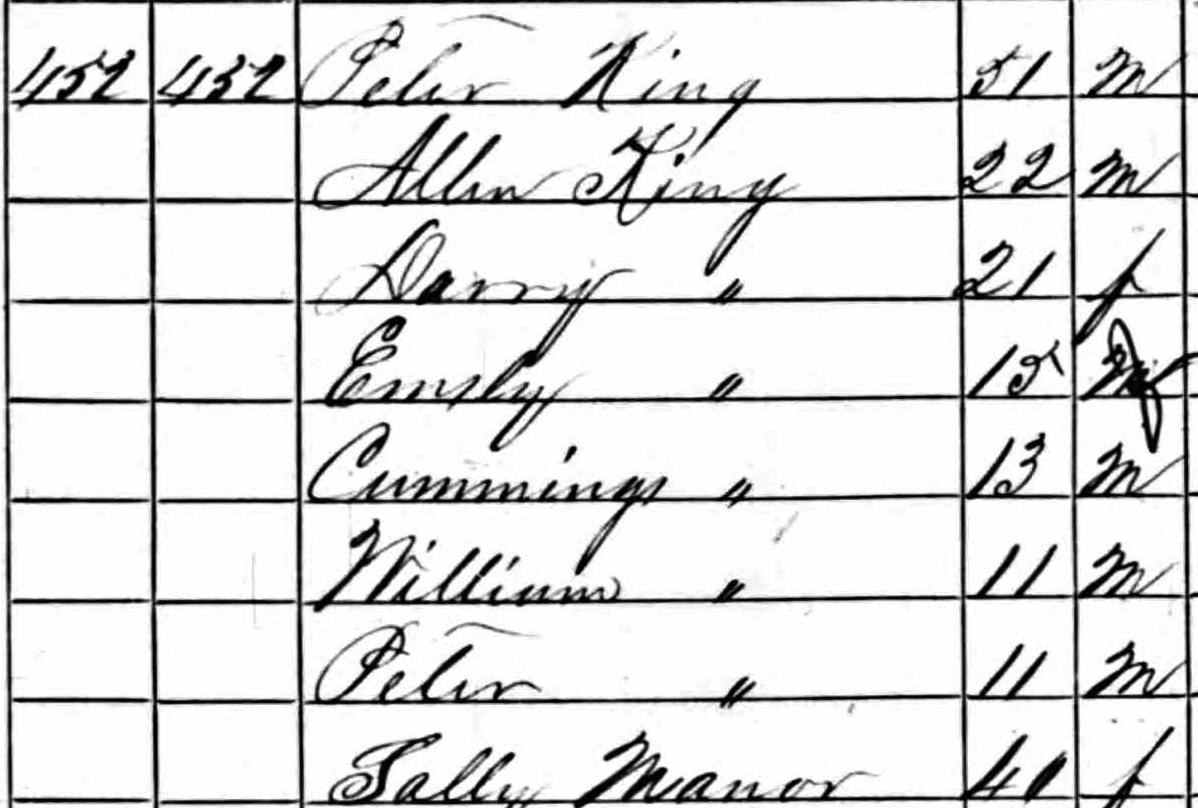
The 1860 census shows him living in Diffies, Montgomery County, North Carolina. Once again, his wife is not present, so I assume she probably died before the 1850 census. All of the same children are living in the house except for Ann, whom I assume has married by this point. Emely (listed as a female in 1850) is now Emsly (listed as male). So, since there are no new children in the household, it is possible that all of the children are, in fact, Peter's own.
Clipping from 1860 census
There is also a 41-year-old woman living with them in the 1860 census named Sally Manor. I do not know anything about her, but I hope to do some digging at some point to find out her relationship to the family. Perhaps she was there as a nanny (unlikely because they were farmers and didn't seem to be very wealthy), or perhaps she was a family member who was just visiting for a while.

The 1870 census shows another new person in the family. This time, it is 30-year-old woman listed in the place a spouse would appear. Her name is difficult to read, but I think it reads something like Ancis T. King. If this is right, then I believe this woman to be Ancez Coal.
Clipping from 1870 census
I have found a marriage certificate for Peter King and Ancez Coal dated 10 February 1866. This would fit with the lady in the 1870 census.
Marriage Licensus for Peter King and Ancez Coal
In addition to Peter's youngest boys, Peter and William (who are either twins or "Irish twins" since they always appear to be the same age or one year apart), there are also some new children in the house now. They are:
  • Lucy King, born about 1858
  • Martitia King, born about 1861
  • George King, born about 1867
  • Ella King, born about 1866
  • (illegible girl's name - maybe Lebsa), born about 1869
If these (last few) are the children of Peter and Ancez, this means Peter would have been about 61 when the last child was born!

The first two children in the household appear to have been born before Peter and Ancez were married. Children out of wedlock was not unheard of in these days, but the 1880 census could shed some more light on the situation.

I believe Peter to have died between the 1870 and 1880 census. I have found what appears to be his widow living in Randleman Mills, Randolph County, North Carolina in 1880. Notice the name differences:
Clipping from 1880 census
Ancez is now listed as "Sarah," the illegible girl's name appears as "Liddia V." and is listed older than George, Ella is now "Mary E." and appears younger than mentioned in the previous census, and finally, Lucy J. and Nancy "Martitia" appear with the last name Cole.

This leads me to believe that Ancez/Sarah was married before she married Peter. (I was able to find a marriage record for Willis Cole and Ancetis Craven dated 23 January 1857 in Randolph County, North Carolina. The 1860 census shows the couple with daughter Jane living in Asheboro, Randolph County, North Carolina, but Ancetis/Ancez/Sarah shows up as Margaret this time!)

So, all of this still does not show Peter's previous spouse(s) name(s) or the names of his parents. I have my speculations and my leads based on other family researchers' efforts, but I haven't found any proof to substantiate any of the claims made yet. Until then, this is what I know.

Sources:
  • 1840 West Pee Dee River, Montgomery County, North Carolina U.S. Federal Census (accessed on Ancestry)
  • 1850 Montgomery County, North Carolina U.S. Federal Census (accessed on Ancestry)
  • 1860 Asheboro, Randolph County, North Carolina U.S. Federal Census (accessed on Ancestry)
  • 1860 Diffies, Montgomery County, North Carolina U.S. Federal Census (accessed on Ancestry)
  • 1870 Little River, Montgomery County, North Carolina U.S. Federal Census (accessed on Ancestry)
  • 1880 Randleman Mills, Randolph County, North Carolina U.S. Federal Census (accessed on Ancestry)
  • Marriage License, Peter King and Ancez Coal (accessed on Ancestry)
  • Marriage License, Willis Cole and Ancetis Craven (accessed on Ancestry)

Sunday, September 20, 2015

Nellie Jane Jenkins

I had my State DAR Fall Forum this weekend, so I again didn't get a chance to prepare a post this weekend. I will instead leave you with the death certificate for my father-in-law's aunt, Nellie Jane Jenkins. He never knew of her until I found her tombstone in the local cemetery. I found her death certificate a few months later.
Death Certificate for the stillborn "infant of Mr. and Mrs. P. A. Jenkins"
I will also attach her tombstone, which is the only record that shows her name.
Copyright Brittany Jenkins, 2011
Sources:
  • Death Certificate, Infant of Mr. and Mrs. P. A. Jenkins (accessed on Ancestry)
  • Tombstone, Nellie Jane Jenkins

Sunday, September 13, 2015

No Post This Week

I had my first DAR meeting as an officer this weekend, so I did not have a chance to prepare a post. Instead, I will leave you with a photo I took at Gettysburg during the 150th anniversary of the Battle.
Copyright, 2013
While I don't know if any men from Randolph County fought with this unit, Ramseur is the name of a town in Randolph County, so I was convinced there had to be a connection. Sure enough, Ramseur was named after Confederate General Stephen Dodson Ramseur. I hope to do a post on him in the future.

Saturday, September 5, 2015

Guilford Charge

While working on my Daughters of the American Revolution-themed Patriots Remembered blog last weekend, I found myself combing the North Carolina Colonial and State Records. I came across something that caught my eye and pertained to my husband's family. This specific excerpt discusses the founding of the German Reformed Churches in North Carolina.

The most exciting part of this document is that it is the only reference I have found that actually suggests the inhabitants of central North Carolina originally migrated from Pennsylvania. While I knew they were German and that a lot of Germans settled in Pennsylvania, I hadn't found satisfactory proof that that's where the people from Guilford and Randolph County came. I have seen a few other researchers suggest that they probably did, but they provided no sources to substantiate their claims. This does that.

The other exciting part of this document is the fact that it mentions several of my husband's family names. The one in particular I was happy to find was the Leinberger name. If I am correct, this name eventually evolved into Lineberry. As with the suggestions that the Germans in Randolph County came from Pennsylvania, I have seen unsourced references to this spelling for the Lineberry family. Until now, I assumed this spelling was just a theoretical possibility; one of the spelling variations the family researchers utilized but didn't actually find documented. This opens up a whole new realm of research avenues for this line of the tree.

The following is the related excerpt I found in the colonial records. Some of the names listed are names I do not recognize, but I hope to do a little extra digging now to see if I can unearth anything on these other names and lines.
It has been mentioned that the Reformed (German) Churches in North Carolina are, owing to their number, weakness and the paucity of ministers, divided into several pastoral charges, and of these we propose to gather what we can of their founders and history. 
GUILFORD CHARGE. 
The immigrants to this region—now making parts of Alamance, Guilford and Randolph counties—came in wagons by the emigrant route of those days from Philadelphia, through Pennsylvania, Maryland and Virginia, bringing their household furniture and farming tools, accompanied by young men coming to seek their fortunes in this new country. These came mostly from the counties of Berks, Lancaster and Schuylkill, and a few from Maryland, from 1745 to 1760, perhaps. This was then Orange and Rowan, and these German settlements were made on the waters of Haw River and its tributaries—Alamance, Reedy Fork, Beaver Creek, Stinking Quarter, Sandy Creek, etc. These were the Albrights, Clapps, Fausts, Holts, Sharps (Scherbs), Laws, Graves (Greff), Summers, Cobbs (Kaubs), Cobles, Swings (Schwenks), Cortners (Goertners), Ingolds, Browers, Keims, Staleys, Mays, Amicks (Emigs), Smiths, Stacks, Neases, Ingles, Leinbergers, Straders, Wyricks, Anthoneys, Scheaffers (Shepherds), Weitzells, Trollingers, Longs, Isleys, Shaffners, Foglemans, Sthars, Brauns, Reitzells, with others. 
Their first place of worship was in a log building near where Law's Church now stands, on the old road from Hillsborough to Salisbury, now in the South-east corner of Guilford County. It was a union Reformed and Lutheran Church. This union was brought to an end by the divergent sentiments growing out of the sentiments and feelings that culminated in the Regulation movement and the rebellion of the colonies. Rev. Samuel Suther, who had recently come from the County of Mecklenburg, an advanced patriot, was the Reformed pastor, and under his inspiring guidance the Albrights Goertners, Clapps, Fausts, the Scheaffers, Ingolds, Schwenks and Leinbergers, who were of Reformed stock, at once moved to a schoolhouse near where the Brick Church now stands, and, there undisturbed by factional differences, erected an altar where to serve God. Suther was pastor until the close of the war, and was the animating spirit of the community. Soon this small log house gave way to a larger and more comfortable place of worship, whose corner-stones a few years since could still be seen. In these years Ludwig Clapp and Christian Faust were Elders, and Ingold and Leinberger Deacons, and even in these dark years the church grew and was prosperous. Rev. Bithahn, of Lincoln, succeeded Suther after three years. His ministry was a short one, he dying suddenly on a Sabbath evening after preaching a long-remembered sermon. His grave is in the Brick Church cemetery unmarked, and to-day no one knows his resting-place. For twelve succeeding years this church was without a pastor. In this time the Rev. Andrew Loretz, with unflagging devotion, four times in the year made visits to the Guilford churches and ministered to their spiritual wants. In 1801 Rev. Henry Dieffenbach became pastor, and for six years had the oversight of this church. He was a student of Dr. John Brown, the apostle of the Reformed Church in Virginia. During this time Jacob Clapp (of Ludwig) and John Greff were Elders. There was now again an interval of fourteen years, during which time the visits of Rev. Loretz were again made annually until his lamented death. It is not to be supposed that these godly people were content with these infrequent ministrations. They were wont to meet in their place of worship on the Sabbath—had services of prayer and praise, when Jacob Clapp (of Ludwig) or the school-master, Scherer, read a selected sermon. In 1812 Captain Wm. Albright, an Elder of the church, a patriot captain of the war of the Revolution, was sent to attend the meeting of the Reformed Synod in Pennsylvania to secure the services of a pastor for the Clapp church, as it was yet called. The Rev. James R. Riley, a young minister, was deputed by the Synod to visit all the Reformed Churches of the South. In 1813 he made the visit on horseback, coming by the emigrant route, and spent several months among the Guilford churches. On October 16th was had a memorial communion, the largest, till then, ever held in the Clapp church. Fifty-seven were added to its membership. On this occasion the old log church, large as it was, could not hold the congregation, and it had become dilapidated and uncomfortable. In their joy and gratitude the congregation proposed to erect a new frame house of prayer, but at the suggestion of Mr. Riley it was determined that it should be of brick. From thence it was no longer the “Clapp” church, but the “Brick” church of the present day. So harmonious and liberal were the people, that no difficulty was experienced in raising the needed funds for the purpose. This was, perhaps in 1814, and in this church's palmiest days, when Captain Albright, John Clapp, Jacob Clapp, George Clapp, Barney Clapp, Col. D. Clapp, Daniel Faust and Daniel Albright were the leading spirits in the church. Still no permanent ministry could be had, owing to the paucity of preachers, and the churches were dependent on the casual visits of missionaries sent by Synod until 1821, when Rev. John Rudy became pastor of the associated churches in Orange, Guilford and Randolph. After a successful ministry of four years he returned to New York. In 1828, the Rev. J. H. Crawford, of Maryland, was elected his successor. His pastorate lasted twelve years. It was now that the pulpit service was heard in the English language. For the welfare of the church this was none too soon. In 1841, Rev. G. William Welker, the present pastor of the church, took charge of it. It is a large congregation, mostly composed of the descendants of those early German immigrants from Pennsylvania. In the grave-yard, hard by the church, rest in unmarked graves Tobias Clapp and Peter Goertner, who were in the Regulation battle; and there also sleep Capt William Albright and Barney Clapp and Matthew Schwenck, and others, who were soldiers in the War of the Regulation, and the passer-by who stops to read may find other humble graves of noble men, and that of George Goertner (Cortner), who was the civil leader of this community of Germans.
Sources:

Saturday, August 29, 2015

Formation of Randolph County

Virginia colonists founded the Carolinas in 1653. In 1664, the first two counties were formed. Albemarle and Clarendon Counties were the original two counties. Albemarle comprised the northern part of the state, and Clarendon the southern part of the state. In 1667, the Clarendon settlement was abandoned; the county was thus discontinued.

By the time Albemarle County was six years old, in 1670, four precincts formed. Starting at the coast and working westward, the precincts were Currituck, Pasquotank, Berkeley, and Shaftesbury. Eleven years later, Berkeley precinct was renamed Perquimans precinct. Just four years later, in 1685, Shaftesbury precinct changed its name to Chowan precinct. In 1689, Albemarle County dissolved leaving behind the four independent precincts.

In 1696, Bath County formed just south of the existing precincts. Nine years later, in 1705, Bath gained its own precincts. Starting at the coast and going westward, the precincts were named Wickham, Pamptecough, and Archdale. (Archdale was slightly south of Pamptecough.)

North Carolina and South Carolina separated from one another into distinct colonies in 1710.

Seven years after Bath segregated in to its precincts, all three precincts changed names. From east to west again, the precincts were now Hyde, Beaufort, and Craven. (Craven was slightly south of Beaufort.)

North Carolina didn't see any changes for about 10 years after that, but in 1722, a couple more changes happened. Chowan precinct, located in the former Albemarle County, splintered into two. Chowan remained the eastern section, and the new precinct Bertie formed in the western section. In Bath County, Craven precinct split into two. Craven remained in the northwestern part of the region, and Carteret precinct took over the southeastern region.

Bath County and precincts of the former Albemarle County saw more changes in 1729. Before now, the northernmost precincts of North Carolina were Currituck, Pasquotank, Perquimans, Chowan, and Bertie. Tyrrell precinct formed from the southernmost portions of Currituck, Pasquotank, Chowan, and Bertie. Because it took from all of those precincts, Tyrrell extended from the intracoastal waterway all the way to the precincts of Bertie and Beaufort. In Bath County, New Hanover precinct broke off from what was previously part of Craven precinct. New Hanover formed near what was originally Clarendon County.

Five years after the formation of New Hanover, the precinct split into three sections. Onslow precinct was the easternmost (and smallest) section, New Hanover remained in the middle, and Bladen was formed from the western most section.

In 1739, all of the "precincts" were redesignated as "counties." This meant North Carolina suddenly went from one county (Bath) and several precincts to having 13 counties. (Bath no longer had any designated area, so it ceased to function as a county.)

Edgecombe and Northampton Counties formed in 1741 from Bertie County. Northampton County claimed a small region in the northern part of the county, while Bertie County remained in the southeastern most section. Edgecombe County now consume the entire western part of the former County extending all the way down cutting off Beaufort County and sharing a new border with Craven County.

Over the next few years, North Carolina's counties saw many changes. In 1745, Hyde County expanded and claimed some of what was previously Currituck County. The next year, Edgecombe and Craven Counties both split. Granville County took over the westernmost part of Edgecombe, and Johnston County took over the westernmost part of Craven. In 1750, Anson formed out of the western part of Bladen and Duplin claimed the upper third of New Hanover.

In 1752, Orange County formed. It was made up of the northeasternmost part of Bladen and the westernmost parts of Granville and Johnston Counties. By now, all the counties in the state had definitive borders with the exception of Anson County, which comprised the western half of the state.

Anson divided into a northern and a southern section in 1753. Anson remained in the southern part, and Rowan County became the northern part. The next year, Cumberland formed in the top half of Bladen County.

Beaufort County took some land from its southern neighbor, Craven, in 1757. Halifax formed in the northeast section of Edgecombe County, and Dobbs County claimed the northernmost part of Johnston County by 1758. The following year, Hertford County formed from a combination of land from Bertie, Chowan, and Northampton. Pitt County formed in the western part of Beaufort County in 1760.

Mecklenburg County formed in 1762 from the western section of Anson County. In 1764, the southernmost tip of North Carolina became Brunswick County after taking land from both Bladen and New Hanover Counties. The same year, the eastern part of Granville County became Bute County. Tryon County took over the western part of Mecklenburg in 1768.

1770 brought a lot of sudden changes in the state. Guilford County formed from the western half of the Orange and the eastern part of Rowan. Wake County formed by taking pieces from Johnston, Orange, and Cumberland Counties. The remaining section of Orange County segmented further so that Chatham County formed out of the lower third of the county. The leftover Rowan County split into a northern and southern portion. The northern portion became Surry County; the lower remained Rowan. And Carteret County gained Ocracoke Island.

A couple of years later, in 1773, Surry took some additional land from Rowan County. Martin County took over the eastern portion of Halifax and the western portion of Tyrell in 1774. By 1776, the western border of the state started to take shape as the District of Washington formed at the ends of Surry, Rowan, and Tryon Counties.

More development came in 1777. Camden formed in the northern section of Pasquotank. Edgecombe's western half became Nash County. Caswell claimed the top part of Orange County. Wilkes County formed out of Surry and the District of Washington. Rowan split, and the western portion became Burke County. And District of Washington became Washington County, located in what is today's Tennessee.

The next year, Gates County formed from pieces of Chowan, Hertford, and Perquimans. The southwest portion of Craven County became Jones. Anson's northernmost part became Montgomery County. And, finally, in 1778, Randolph County formed in the lower portion of Guilford County.
Map highlighting Randolph County, North Carolina from ncpedia.org
North Carolina's counties have changed a lot since 1778, meaning Randolph's bordering counties changed a few times in the coming 100 years, but Randolph County's borders haven't changed much themselves. Today, Randolph County shares its borders with Alamance, Chatham, Davidson, Guilford, Montgomery, and Moore.

Sources:

Saturday, August 22, 2015

James C. and Martitia Stout

My husband's fourth great-grandmother was a Stout. (Sarah Stout, born about 1807 in North Carolina, to be specific.) His Stout family is actually proving to be rather difficult to research. (All I have is a name and an estimated birth from a census!) To help try and figure out the family, I started working researching all the Stouts in the area hoping I may come across the right Stout family. That's how I found this branch.

James Calvin Stout is an in-law of an in-law of an in-law in my husband's tree. I actually have two James Calvin Stouts in the tree, but for this post I'll stick to the younger one. He was born about 1862 to Calvin Newton Stout (son of the older James Calvin Stout) and Emily J. Bray.

James married Susana Martitia Brown on 25 September 1881 in Randolph County, North Carolina.
Clipping from the Randolph County, North Carolina Marriage Record Book
I don't know anything about her except her estimated birth (about 1862) from census records. I do know that, together, they had at least four children.
  • William Oscar Stout, born about 1884
  • Fannie Stout, born about 1893
  • Leslie Stout, about 1897
  • Annie Stout, about 1902
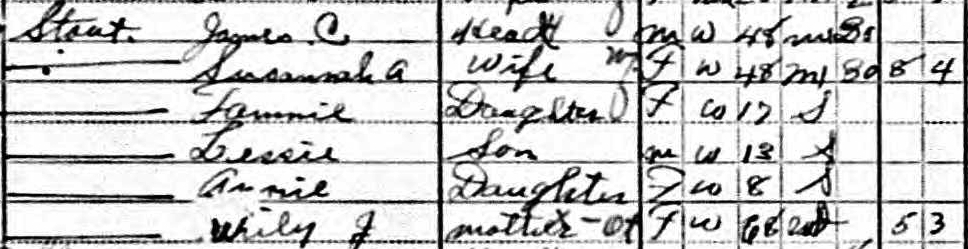
Clipping from the 1900 Census
Clipping from the 1910 Census
It seems from the census that for his entire life, James lived in Columbia, Randolph County, North Carolina. (I have yet to find him in the 1880 census, but I have a feeling if I comb page-by-page through the Columbia census of that year, that I will find him.)

He was listed as a farmer, as was his father before him. Since he was too young in the 1870 census to be a farmer in his own right, and I have yet to find him in the 1880 census, I do not have any agriculture census records for James. I hope to look into his father's records a little more to see if I can guess what kinds of crops James may have tended, but that's a post for another day.

James died on 8 March 1935 in Columbia, North Carolina. His cause of death was myocarditis, but I can't read one of the contributing factors. I can tell it says "and broncho-pneumonia," but I can't make out the first word.
Clipping from Death Certificate of James Calvin Stout
I hope to ask someone with more of a medical background about this later to see if they can make it out.

Sources:
  • 1870 Columbia, Randolph County, North Carolina U.S. Federal Census (accessed on Ancestry)
  • 1900 Columbia, Randolph County, North Carolina U.S. Federal Census (accessed on Ancestry)
  • 1910 Columbia, Randolph County, North Carolina U.S. Federal Census (accessed on Ancestry)
  • 1920 Columbia, Randolph County, North Carolina U.S. Federal Census (accessed on Ancestry)
  • 1930 Columbia, Randolph County, North Carolina U.S. Federal Census (accessed on Ancestry)
  • Death Certificate, James Calvin Stout (accessed on Ancestry)
  • Marriage Records for Randolph County, North Carolina (accessed on Ancestry)

Saturday, August 15, 2015

Daniel and Sarah Elizabeth Tickle

I realized I never hit "publish" on this post! Rather than back post it, I have simply replaced this week's scheduled post with what was supposed to be last week's post. Sorry for the technical glitch!

The last few weeks' posts have featured families and topics in North Carolina. This week, I thought I would take us back to Virginia.

Sarah Elizabeth ("Betsey") Lineberry was born about 1802 in North Carolina. She was the third of 12 children born to Jacob Lineberry, IV and Mary Elizabeth Fanning. 

Betsey married Daniel Tickle on 22 November 1819 in Guilford County, North Carolina. Daniel was born about 1800 in North Carolina to John W. Tickle, Jr. and Elizabeth Cockelress.
Daniel and Betsey's Marriage Record
Betsey and Daniel had at least the following children:
  • Salome Tickle, born about 1820
  • Hezekiah C. Tickle, born about 1825
  • Peter Conrad Tickle, born 25 August 1830
  • Solomon Tickle, born about 1831
  • Daniel Lineberry Tickle, born 13 October 1833
  • Mary Tickle, born about 1835
  • Harvey Bennett Tickle, born 26 November 1839
  • Molly Adaline Tickle, born about 1840
All of the children were born in North Carolina, but it seems the entire set of children moved to Virginia when Daniel and Betsey did. (Salome is the only child that stayed in North Carolina since she was married by 1848.) Family legend says they moved to Bland County, Virginia in 1846. In reality, it looks as though they moved around a little bit before finally ending up in Bland County.

For the 1850 census, they were living in Giles County, Virginia.
Clipping from 1850 Census
In 1860, they are living in Wytheville, Wythe County, Virginia.
Clipping from 1850 Census
Then, in 1870, they finally end up in Seddon, Bland County, Virginia. By 1880, they have settled in Mechanicsburg, Bland County, Virginia.
Clipping from 1880 Census
Betsey is listed in the Virginia Deaths and Burials Index as having died 15 January 1880 in Bland County, Virginia. If that is the case, however, that would leave me to believe the Elizabeth, age 70, living with Daniel in the 1880 census is actually a second spouse of Daniel's. (It is possible that Elizabeth died in June instead of January if it was a mis-transcription. I have not been able to locate a copy of the actual record yet, so I can not say one way or the other what the situation is.)

I have not found a death record for Daniel yet. I assume he died some time between 1880 and 1900. Without a copy of the 1890 census, I think that may be as narrow as I can get that date range for now.

Sources:
  • 1850 Giles County, Virginia U.S. Federal Census (accessed on Ancestry)
  • 1860 Wythe County, Virginia U.S. Federal Census (accessed on Ancestry)
  • 1860 Wytheville, Wythe County, Virginia U.S. Federal Agricultural Census (accessed on Ancestry)
  • 1870 Seddon, Bland County, Virginia U.S. Federal Census (accessed on Ancestry)
  • 1880 Mechanicsburg, Bland County, Virginia U.S. Federal Census (accessed on Ancestry)
  • Guilford County North Carolina Marriage Records, Daniel Tickle and Betsey Linebury (accessed on Ancestry)
  • Orange County North Carolina Marriage Records, John C. Low and Sally Tickle (accessed on Ancestry)
  • Virginia, Deaths and Burials Index, Elizabeth Tickle (accessed on Ancestry)

Saturday, August 1, 2015

The Unknown Solomon Lineberry

Sometimes, in genealogy, you come across a mystery. Maybe someone recorded or assumed something incorrectly online and that myth was perpetuated over and over again until people believed it to be truth. Then, as a thorough research, you come across the undocumented name, date, place, or relationship, and you realize there was no basis whatsoever for the initial assumption. The rest of your searches all seem to be focused around proving or disproving what that one person said before you.

The biggest mystery in my husband's family revolves around a man named Solomon Lineberry.

Here's what I know about Solomon. He was born sometime between 1805 and 1810. I know he married a Katharine (or Catharine) M. at least before the 1850 census. Together, they had at least the following children:
  • Mebane Lineberry, born about 1831
  • Lavinia or Levina Lineberry, born between 1834 and 1839
  • Delphine or Delphina Lineberry, born about 1839
  • Peter Lineberry, born between 1833 and 1835
  • Sophronia or Sophia Lineberry, born between 1838 and 1841
  • Leonard Lineberry, born between 1840 and 1842
  • Angeline Lineberry, born between 1843 and 1844
  • Madison Lineberry, born between 1845 and 1849
  • Oliver "Adison" Lineberry, born 15 November 1846
Clipping from the 1850 Guilford County, North Carolina Census showing household of Solomon Lineberry
The first time I came across this family, it was recorded that Solomon was the son of Jacob Lineberry, III, the Revolutionary War Patriot, whom I showcased a few months ago. While Jacob did have a son named Solomon, that Solomon was born about 1800 according to the 1850 census, though most believe him to be born in 1787.
Clipping from the 1850 Randolph County, North Carolina Census showing the household of the older Solomon Lineberry. (He is living next door to his son, Jacob, and two doors down from his nephew, Emerson, here.)
While it was not uncommon for a family to reuse a name when another child previously died, the older Solomon never died. He lived at least until the 1850 census and married and had children of his own.

Another family researcher, Frances Harding Casstevens, wrote a book about her ancestor, the mysterious Solomon Lineberry.
Photo of book cover as found at Randolph Room, Asheboro Branch, Randolph County Public Library
This is her description of how she thinks her ancestor fits in with the rest of the Lineberry family.
"From what information we have been able to gather, I and other members of the family believe that our ancestor, Solomon Lineberry, was the son or grandson of Jacob Lineberry of Randolph county who married Mary Catherine Youngblood. It is known that Mary Catherine Youngblood was of German and Indian descent. The Indian blood appears even yet in the descendants. A picture of Eliza Lineberry Bowman shows this quite clearly. It appears elsewhere in the book.
 Jacob Lineberry's will names a son 'Solomon' but as there were two Solomon Lineberrys in Randolph county it is difficult to determine which was Jacob's son and which was the grandson. A book on the Lineberry family by Capt. W. S. Lineberry, written in 1918, gives all of the children and grandchildren of Jacob Lineberry, except those of John who is named in the will but left entirely out of the genealogy written by Capt. W. S. Lineberry who relied mostly on memory in compiling his family history. If our theories are correct, then our Solomon is the son of this John and Solomon's brothers and sisters were Eva (Moss); Macklen; Peter; and possibly others. As the 1820 Randolph County census is lost we may never be able to correctly determine this."
It is my opinion that Frances' Solomon could very well be the child of John, but I have not found solid evidence of that yet. I am fairly certain, however, that her Solomon was simply too young to have been Jacob's son.

If you know anything about this family or if you descend from either of these two Solomons, please send me a message or comment on this post. I would love to share information and attempt to untangle this particular portion of the family tree.

Sources:
  • 1850 Northern Division, Randolph County, North Carolina U.S. Federal Census (accessed on Ancestry)
  • 1850 Southern Division, Guilford County, North Carolina U.S. Federal Census (accessed on Ancestry)
  • 1860 Flint Hill, Yadkin County, North Carolina U.S. Federal Census (accessed on Ancestry)
  • Casstevens, Frances Harding "The Descendants of Solomon Lineberry" (accessed at the Randolph Room, Asheboro Branch, Randolph County Library)
  • Tombstone, Ad Lineberry (as viewed on Find-A-Grave)