Translate

Showing posts with label Gray. Show all posts

Saturday, March 14, 2015

William Vester Trogdon

William "Vester" Trogdon was born 17 February 1899 in Randolph County, North Carolina. He was the fifth of 11 children born to Francis Marion Trogdon and Mary Virginia Owen Lineberry. Vester lived his entire life in the town of Franklinville, located in Randolph County, North Carolina. I don't know much about Vester beyond that which can be found in public records, but this is what I know.

Vester had a fourth grade education, which makes sense because his father was always in some sort of trade. I don't know where he went to school, but I doubt he would have met his future wife, Minnie Elisa Gray, while in school. She was seven years younger being born 28 March 1906. (Minnie had a seventh grade education. Since her father was a carpenter, a somewhat higher level of education would make sense for her and her family.)

Vester lived in Franklinville with his parents and siblings until he got married in 1921. She, too, lived in Franklinville her entire life. I think they probably met each other some time between 1910 and 1920 when Vester and his family moved down the road from Minnie. Before then, Vester was living in what was called West Franklinville in the 1910 census. I'm not sure what parts of town this actually covered, you can kind of tell from the enumeration district map the general idea.
Randolph County Enumeration District Map for 1920 Census
I wonder if Vester's family moved due to his father's (seemingly constant) change in occupation. In 1900, Francis Trogdon was a mechanic. He was living in an un-mortgaged house which wasn't located on a farm. In 1910, he shows up as a blacksmith owning his own shop, however, now he is living on a farm which carries a mortgage located in West Franklinville. (The older boys of the house seem to be the ones working the farm.) Then, in 1920, Francis is a machinist with his own shop with all of his older boys working with him in the shop. They live, probably in the same house, on a farm still, but now they are listed as owning the farm "freely" without a mortgage.

I wish I knew a little bit about Francis' machinist shop and the kinds of tools they made. Were they mechanic tools? Were they farming tools? Or were they tools to assist with the cotton mill that seemed to be the place to work in town? I think a wise machinist would cater to all three areas at least, but I like to at least think they helped the cotton mill from time to time because that's where Minnie was working in 1920 as a spinner.
Clipping from 1920 census showing Minnie's occupation
Franklinsville Manufacturing Company
1306 Andrew Hunter Road, Franklinville
As I said earlier, Vester and Minnie got married in 1921. They set up home, as you would have guessed, in Franklinville where they each grew up. By 1930, they own their own farm home with a total value of $400.
Clipping from the 1930 Census
Vester and Minnie were the only one of their neighbors with a radio!
Minnie came home from working at the mill, probably to be with the kids, and Vester ended up getting a job there as a loom fixer where he was still working in 1940. In 1940, the value of their home increased to $500, and Vester's income was stated to be $1,300 in the census.
Clipping from 1940 census showing Vester's occupation and salary
Vester and Minnie had a total of five children:
  • Grace "Yvonne" Trogdon
  • Gouldia Gray Trogdon (who died at two weeks old)
  • Edith Maude Trogdon
  • Helen Faye Trogdon
  • William Gene Trogdon
They are buried at Grays Chapel United Methodist Church Cemetery.
Copyright Brittany Jenkins, 2011
Sources:
  • 1900 Franklinville, Randolph County, North Carolina U.S. Federal Census (accessed on Ancestry)
  • 1910 Franklinville, Randolph County, North Carolina U.S. Federal Census (accessed on Ancestry)
  • 1910 West Franklinville, Randolph County, North Carolina U.S. Federal Census (accessed on Ancestry)
  • 1920 Franklinville, Randolph County, North Carolina U.S. Federal Census (accessed on Ancestry)
  • 1930 Franklinville, Randolph County, North Carolina U.S. Federal Census (accessed on Ancestry)
  • Enumeration District Maps (accessed on FamilySearch)
  • Randolph County Historic Landmark Preservation Commission - Franklinsville Mfg. Co.
  • Tombstone, W. Vester and Minnie G. Trogdon (photo taken Christmas 2011)
  • Town of Franklinville, NC

Saturday, March 7, 2015

W. S. Lineberry

The following is a post from my Civil War blog, Civil War Souls, about a man born and raised in Randolph County. His name was W. S. Lineberry. (If you enjoy this take on Civil War history, I invite you to subscribe to my Civil War blog where I will be posting bi-weekly.)

For my first post on this blog, I couldn't think of a better subject than Winfield Scott Lineberry. It was his account of his experience in the US Civil War that got me interested in Civil War history. Now I will try to share that history with you.

Winfield Scott Lineberry was born 2 April 1847 in Locust Grove, Randolph County, North Carolina at the farm home of his parents. He was the 8th of 9 children born to Lemuel and Sally Hanner Lineberry.

When Scott was just 14, the War started. I'll let him tell you himself what his experience was like. This was taken from his "Biography of the Lineberry Family," which he wrote in 1918.
"When I saw the men volunteering and drilling, oh, how I did want to go too, but my father and mother told me I was too young. However, I had an ambition to be a military man, so I studied the army tactics and became a drillmaster.  After I was 15 I was a pretty good drillmaster and was elected first lieutenant of the state militia, but this did not put me in the regular army where I could shoot Yankees, and this was the height of my ambition.  When the first draft came on, which I believe was in 1862, I was elected first lieutenant of the drafted men.  Now I thought I was going to get to don a uniform and go and fight Yankees, but that night when I came home my hope was cut in the bud, for my parents told me I was too young and could not go, but in April, 1864, all between 17 and 18 were called to the colors, so we met in Asheboro and organized and I was again elected first lieutenant and Will Foust was elected captain.  We were ordered out the 25th of May and when we got to Raleigh we had to reorganize and I was elected captain.  My company was put in the first regular junior reserves as Company F.  We later became the 70th Regular N. C. Troops.  We drilled in Raleigh sometime.  I had in my company 110 men, as fine a looking set of boys as ever shouldered a musket and I must say I was proud of them."
 

According to the book, "Histories of the Several Regiments and Battalions," the other officers in W. S. Lineberry's 70th NC Troop, Company F, included 1st Lieutenants L. S. Gray and H. C. Causey, 2nd Lieutenants H. C. Causey, Z. T. Rush, W. T. Glenn, and W. R. Ashworth.
Clipping from "Histories of the Several Regiments and Battalions"
"I soon had them well drilled, as I had had some experience in drilling, and we were soon transferred to Weldon.  There was a lot connected with this young life of mine that I would like to tell you, but it would consume too much space, so I must hasten on. 
The first time we had the pleasure of meeting the bluecoats was at a place called Poplar Point, on the Roanoke River.  We sunk three gunboats (one got away) and put the Yankees to flight.  I think that was one of the happiest nights I ever spent.  I had tested my boys and saw they had the grit and would fight I was prouder of them than I was before. 
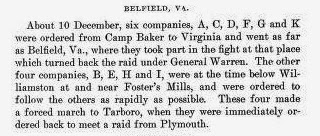
Our next fight was at Bellfield, Va.  We fought the Yankees all day and laid in line of battle all night.  That night there came a big sleet which froze our blankets to our clothes.  Next morning when light came, to our surprise the Yankees were gone.  They left the ground covered with dead, which proved we had not shot wild.  We pursued them several miles, but could not overtake them, so we came back to North Carolina."
Clipping from "Histories of the Several Regiments and Battalions"
"Our next fight was at Kinston the last of March.  Here we held an army four times our number three days, and many a Yankee we made turn up his toes, but on the third night the Yankees found they could not break our lines.  They commenced moving so as to cut us off from Raleigh, so we had to fall back to Smithfield.  I was slightly wounded in this fight, but never left the battle field.  Our next fight was at Bentonsville, near Smithfield.  Here Joe Johnson, our commander, had to fight not only the army we fought at Kinston, but all of Bill Sherman’s grand army.  They had at least six men to our one, but notwithstanding this our grand army, which was half-naked and half-starved, held all this powerful army in check for three days and nights and many were the dead bluecoats we left on the field.  When they found they could not break our lines they again tried to cut us off from Raleigh, so we had to fall back again.  When he got to Raleigh we heard the news of Lee’s surrender, so Johnson marched us to Greensboro and surrendered to Sherman, and this ended the war.  We surrendered April 27, 1865."
I think the thing that makes me love the story of Winfield Scott Lineberry so much is the fact that it was so many other soldiers' story as well. He was a young boy who was, technically, too young to fight, but he didn't let that stop him. Not only did he not let that stop him from fighting, he didn't let that stop him from becoming a Captain.

As far as I know, he was the only one of his siblings who fought as well. His siblings were "hatters" by trade for most of their careers. Perhaps they "served" by supplying soldiers during the War? Further investigation into any possible connection to the War with his older brothers is still needed.


Probably the most impactful part of Scott's story, though, is the aftermath of the war. His story continues in his "Biography" after he got home from the war.
"On April 28th, 1865, I put foot in my old home once more with nothing in this world only the old clothes on my back and they were ragged—not a dollar in the world.  I was sick on our retreat and put my knapsack in a baggage wagon with my uniform, which was nearly new, and all my belongings except my Bible, and I never saw the knapsack any more.  I found everything at home impoverished and I felt like I had rather be dead than alive.  I went to work on the farm with but little to work with."
Five and a half years after the end of the Civil War, Scott got married and began his family. They had nine children. He stayed rather close to other Civil War veterans during the remainder of his life. He served as US Deputy Marshal briefly. He spent some time as a storekeeper under a man who served as a Colonel in the War (who later became a US Senator). Then, in 1910, he became the superintendent of the Confederate Soldier's Home in Raleigh, North Carolina.
Confederate Soldier's Home in Raleigh, NC
Postcard. Image from goodnightraleigh.com
Winfield Scott Lineberry died 20 June 1926. He is buried in Grays Chapel United Methodist Church Cemetery, which is located in Franklinville, Randolph County, North Carolina.
Capt W. S. Lineberry and Hulda Louisa Vickory Lineberry
Copyright Brittany Jenkins, 2011
Capt. W. S. Lineberry's Signature
as taken from a letter written during the War.
Found in his service records.
Sources: