Translate

Showing posts with label Foust. Show all posts

Saturday, March 28, 2015

Rebecca C Kirkman

I was originally going to post this week about David Harris Foust, my husband's second great-grandfather. Then, after looking into him, I found his wife, Rebecca C. Kirkman, to be a much more fascinating individual.

Rebecca Kirkman was born 10 February 1845 to William Kirkman and Mary (last name unknown). At about 15 years old, on 10 November 1861, she had her first child, Martitia Lee Ward. Martitia's father is assumed to be Zeno Ward. Zeno may not have known Rebecca was even pregnant when he enlisted with his brother, Minus, in the 22nd North Carolina Infantry, a part of the Confederate States Army, on 18 June 1861.
Taken from Service Records
He originally enlisted for 12 months, but he ended up staying until October 1864.

Zeno had an eventful experience in the War. Less than six months after enlisting, he catches pneumonia and is hospitalized. He was shot in May 1863 to the point of needing surgery at the hospital in Richmond, Virginia. He was later wounded again and captured at Gettysburg. After Gettysburg and his time as a POW, it seems he was furloughed. But then, in May 1864, he was listed as being absent without leave.
Taken from Service Records
I almost got mad at Zeno at this point. His brother, Minus, seemed to be absent a lot from the War, but Zeno stuck around even with everything he had been through. As a soldier who had experienced so much, it seemed like now he was simply running away from the War. But, instead, I found he was doing something much more honorable.

On 8 May 1864, he married Rebecca back home in Randolph County, North Carolina.

Maybe Minus had found out about his child while he was absent from the War, and maybe somehow he got the word to Zeno. In any case, I find Zeno's actions very honorable. I like him very much!

In 1870, he is seen living down the road from his parents in Sandy Creek in Liberty, Randolph County, North Carolina with Rebecca, Martitia, and another child, Alfred T. (Alfred was born in 1865. I have a feeling he was a honeymoon baby.)
Clipping from 1870 census
Then, in 1872, Zeno died. I haven't found any information yet on the cause of death, but I find it sad that this man lived through so much and still died at 32 years old.

Rebecca seems to have not wasted any time though in finding another man to support her and her children. While I don't know who she married (if she married) after Zeno, she had two more children in the mid-1870's. They appear in the 1880 census carrying the last name Ward.
Clipping from 1880 census
Also listed in the household in 1880 is a man named D H Foust. This is the same David Harris Foust I initially wanted to feature. David and Rebecca married in 1880 apparently after the census was enumerated.
Clipping from 1880 census
According to the 1930 census, David may have been married once before Rebecca, but I have not found the name of that potential spouse.
Clipping from 1930 census showing David's age at first marriage being 16
In the 1900 and 1910 censuses, it has a column that lists the number of children each woman has had and how many of them are still living. Each of those censuses states she has had eight children. In 1900, six of them are still living, but only five of them are living in 1910.
Clipping from 1900 census
I know of seven children born to Rebecca before 1900, so I seem to be missing one. I also don't know when most of her children died. Here's what I know:

Children of Zeno and Rebecca:
  • Martitia Lee Ward, b. 1861, d. 1931
  • Alfred T Ward, b. 1865
  • Ella C Ward, b. 1869
Children of Unknown and Rebecca:
  • Mary J Ward, b. 1874
  • Martha C Ward, b. 1876
Children of David and Rebecca:
  • John W Foust, b. 1883
  • Maud Elsie Foust, b. 1886, d. 1973
Rebecca, David, and Zeno are all buried at Grays Chapel United Methodist Church Cemetery.
David H. and Rebecca C. Foust
Copyright Brittany Jenkins, 2011
Sources:
  • 1870 Sandy Creek, Liberty, Randolph County, North Carolina U.S. Federal Census (accessed on Ancestry)
  • 1880 New Salem, Randolph County, North Carolina U.S. Federal Census (accessed on Ancestry)
  • 1900 East Franklinville, Randolph County, North Carolina U.S. Federal Census (accessed on Ancestry)
  • 1910 East Franklinville, Randolph County, North Carolina U.S. Federal Census (accessed on Ancestry)
  • 1930 Franklinville, Randolph County, North Carolina U.S. Federal Census (accessed on Ancestry)
  • Compiled Service Records of Confederate Soldiers Who Served in Organizations from the State of North Carolina (accessed on Fold3)
  • Tombstone, David H. and Rebecca C. Foust (photo taken Christmas 2011)
  • Tombstone, Zeno Ward (photo taken Christmas 2011)

Saturday, March 7, 2015

W. S. Lineberry

The following is a post from my Civil War blog, Civil War Souls, about a man born and raised in Randolph County. His name was W. S. Lineberry. (If you enjoy this take on Civil War history, I invite you to subscribe to my Civil War blog where I will be posting bi-weekly.)

For my first post on this blog, I couldn't think of a better subject than Winfield Scott Lineberry. It was his account of his experience in the US Civil War that got me interested in Civil War history. Now I will try to share that history with you.

Winfield Scott Lineberry was born 2 April 1847 in Locust Grove, Randolph County, North Carolina at the farm home of his parents. He was the 8th of 9 children born to Lemuel and Sally Hanner Lineberry.

When Scott was just 14, the War started. I'll let him tell you himself what his experience was like. This was taken from his "Biography of the Lineberry Family," which he wrote in 1918.
"When I saw the men volunteering and drilling, oh, how I did want to go too, but my father and mother told me I was too young. However, I had an ambition to be a military man, so I studied the army tactics and became a drillmaster.  After I was 15 I was a pretty good drillmaster and was elected first lieutenant of the state militia, but this did not put me in the regular army where I could shoot Yankees, and this was the height of my ambition.  When the first draft came on, which I believe was in 1862, I was elected first lieutenant of the drafted men.  Now I thought I was going to get to don a uniform and go and fight Yankees, but that night when I came home my hope was cut in the bud, for my parents told me I was too young and could not go, but in April, 1864, all between 17 and 18 were called to the colors, so we met in Asheboro and organized and I was again elected first lieutenant and Will Foust was elected captain.  We were ordered out the 25th of May and when we got to Raleigh we had to reorganize and I was elected captain.  My company was put in the first regular junior reserves as Company F.  We later became the 70th Regular N. C. Troops.  We drilled in Raleigh sometime.  I had in my company 110 men, as fine a looking set of boys as ever shouldered a musket and I must say I was proud of them."
 

According to the book, "Histories of the Several Regiments and Battalions," the other officers in W. S. Lineberry's 70th NC Troop, Company F, included 1st Lieutenants L. S. Gray and H. C. Causey, 2nd Lieutenants H. C. Causey, Z. T. Rush, W. T. Glenn, and W. R. Ashworth.
Clipping from "Histories of the Several Regiments and Battalions"
"I soon had them well drilled, as I had had some experience in drilling, and we were soon transferred to Weldon.  There was a lot connected with this young life of mine that I would like to tell you, but it would consume too much space, so I must hasten on. 
The first time we had the pleasure of meeting the bluecoats was at a place called Poplar Point, on the Roanoke River.  We sunk three gunboats (one got away) and put the Yankees to flight.  I think that was one of the happiest nights I ever spent.  I had tested my boys and saw they had the grit and would fight I was prouder of them than I was before. 
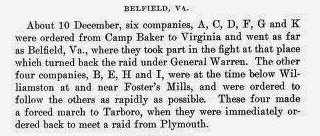
Our next fight was at Bellfield, Va.  We fought the Yankees all day and laid in line of battle all night.  That night there came a big sleet which froze our blankets to our clothes.  Next morning when light came, to our surprise the Yankees were gone.  They left the ground covered with dead, which proved we had not shot wild.  We pursued them several miles, but could not overtake them, so we came back to North Carolina."
Clipping from "Histories of the Several Regiments and Battalions"
"Our next fight was at Kinston the last of March.  Here we held an army four times our number three days, and many a Yankee we made turn up his toes, but on the third night the Yankees found they could not break our lines.  They commenced moving so as to cut us off from Raleigh, so we had to fall back to Smithfield.  I was slightly wounded in this fight, but never left the battle field.  Our next fight was at Bentonsville, near Smithfield.  Here Joe Johnson, our commander, had to fight not only the army we fought at Kinston, but all of Bill Sherman’s grand army.  They had at least six men to our one, but notwithstanding this our grand army, which was half-naked and half-starved, held all this powerful army in check for three days and nights and many were the dead bluecoats we left on the field.  When they found they could not break our lines they again tried to cut us off from Raleigh, so we had to fall back again.  When he got to Raleigh we heard the news of Lee’s surrender, so Johnson marched us to Greensboro and surrendered to Sherman, and this ended the war.  We surrendered April 27, 1865."
I think the thing that makes me love the story of Winfield Scott Lineberry so much is the fact that it was so many other soldiers' story as well. He was a young boy who was, technically, too young to fight, but he didn't let that stop him. Not only did he not let that stop him from fighting, he didn't let that stop him from becoming a Captain.

As far as I know, he was the only one of his siblings who fought as well. His siblings were "hatters" by trade for most of their careers. Perhaps they "served" by supplying soldiers during the War? Further investigation into any possible connection to the War with his older brothers is still needed.


Probably the most impactful part of Scott's story, though, is the aftermath of the war. His story continues in his "Biography" after he got home from the war.
"On April 28th, 1865, I put foot in my old home once more with nothing in this world only the old clothes on my back and they were ragged—not a dollar in the world.  I was sick on our retreat and put my knapsack in a baggage wagon with my uniform, which was nearly new, and all my belongings except my Bible, and I never saw the knapsack any more.  I found everything at home impoverished and I felt like I had rather be dead than alive.  I went to work on the farm with but little to work with."
Five and a half years after the end of the Civil War, Scott got married and began his family. They had nine children. He stayed rather close to other Civil War veterans during the remainder of his life. He served as US Deputy Marshal briefly. He spent some time as a storekeeper under a man who served as a Colonel in the War (who later became a US Senator). Then, in 1910, he became the superintendent of the Confederate Soldier's Home in Raleigh, North Carolina.
Confederate Soldier's Home in Raleigh, NC
Postcard. Image from goodnightraleigh.com
Winfield Scott Lineberry died 20 June 1926. He is buried in Grays Chapel United Methodist Church Cemetery, which is located in Franklinville, Randolph County, North Carolina.
Capt W. S. Lineberry and Hulda Louisa Vickory Lineberry
Copyright Brittany Jenkins, 2011
Capt. W. S. Lineberry's Signature
as taken from a letter written during the War.
Found in his service records.
Sources:

Saturday, February 14, 2015

William Marshall Lineberry

William Marshall Lineberry was born on 8 March 1918 in Providence, Randolph County, North Carolina. He was the fourth of eight children born to William Gaston Fletcher Lineberry and Maude Elsie Foust.

At the age of 18, on 26 December 1936, he married Lois Mozelle Saunders.


Together, they had three children.
  1. Elsie Louise Lineberry
  2. James Marshall Lineberry
  3. Angela Frances Lineberry
They also raised a nephew, Dennis Saunders, as one of their own. 

For my first post on this blog, I wanted to highlight someone who was important from my husband's childhood. My mind immediately went to his Paw-paw Lineberry. I asked Andrew what he remembered about the relationship between his grandparents. He couldn't tell me much as he was very young when they were still alive, but he did tell me something interesting.

When Marshall's youngest grandsons knew him, he and Lois were sleeping in separate bedrooms. This got me curious to know more about their relationship together. I called their youngest daughter, Angie, my mother-in-law, for more information about them. She did not disappoint! Here's what I found out.

Marshall and Lois first met while Lois was babysitting near Grays Chapel School. Marshall was driving a school bus at the time, and when she saw him, she decided right then that he was the man she was going to marry.

Lois had attended Franklinville School, while Marshall had attended Grays Chapel School, so they didn't know each other growing up. But Lois didn't let that stop her. She wasn't allowed to go on "double-dates," but she was allowed to meet him with a group of people (even if it was a group of guys and she was the only girl) in order to see each other. That's how their relationship began.

When I first asked Angie about her parents and their relationship, the first thing she said was, "At the time my mom died, they had been married for 61 years. They never fought or fussed, at least not in front of us kids." She said they were very family-oriented and wanted to keep all of their kids close to them. This only got stronger as their kids started having kids of their own.

When Angie talked about how her parents spoiled their grandkids, she told me they each had their own way of going about it.

Granny Lineberry would spoil them by playing Uno games with them (a game that is still very prevalent in my husband's family). Her grandson, Andrew, recalls she was "ruthless" when it came to playing Uno. She did not just let them win. She also spoiled them by cooking them whatever foods and desserts they wanted to eat. She "loved on" the kids, Angie said.

Paw-paw, on the other hand, gave the kids things, money or gifts, to spoil them. He also hated green beans, so he never made the grandkids eat them. Instead, he would give them chocolate pudding and bananas... foods he enjoyed. Andrew shared his dislike of green beans. In fact, he still hates green beans to this day. I find it funny, though, that green beans were one of his Granny Lineberry's favorite foods.

Lois passed away in 1999. When I asked Angie how Marshall was affected by her death, she said she thinks he "about mourned himself" to death. Marshall died just two years later on 12 October 2001 in Asheboro, Randolph, North Carolina. He was 83. He is buried next to his wife at Grays Chapel United Methodist Church Cemetery. which is located at Franklinville, Randolph County, North Carolina.

So, despite their decisions to sleep in separate rooms, I think it is clear their relationship was a loving one. It was family-oriented and, while Marshall wasn't known as a "romantic," he let everyone around him feel the effects of his love for his wife.

"She was a good woman."
-Marshall Lineberry

Sources:
  • Andrew Jenkins, grandchild
  • Angie Jenkins, child
  • Photos provided by Angie Jenkins